A psychological horror film, Obsession, is running at the box office in India. Directed by Curry Barker, the drama follows the unusual consequences of a simple wish for love that turns into a nightmare. The lead female character becomes ‘violently obsessed’ with the man. FTII scriptwriting faculty Samvartha Sahil wrote a compelling sociological interpretation of the movie. In his review, he made a comment on today’s idea of love and relationships. He said, “The film criminalises and demonises simple human feelings and emotions. It contributes to a market-driven culture that benefits from breaking human connections.” He further wrote, “It is not a coincidence that this is also the time in history when humans are made to forget that they are relational beings. Isolated humans, disconnected from others and themselves, become very profitable to the capitalistic society. Hence, connections have to be villainised so that people opt out of them voluntarily.”
This diagnosis of a culture that profits from severed connection is a useful thread to pull into the discourse around Aamir Khan’s third marriage. The “perfectionist” actor married Gauri Spratt on 5th July 2026 in an intimate, private ceremony. Advertised as low-key, the wedding still became the week’s biggest talking point: rich fodder for meme pages, but also a genuine flashpoint for anxieties about what marriage as an institution is supposed to mean. This isn’t an ordinary man marrying for the third time. It is a superstar whose choices are never received as merely personal, making an implicit statement on the sanctity of the institution itself.
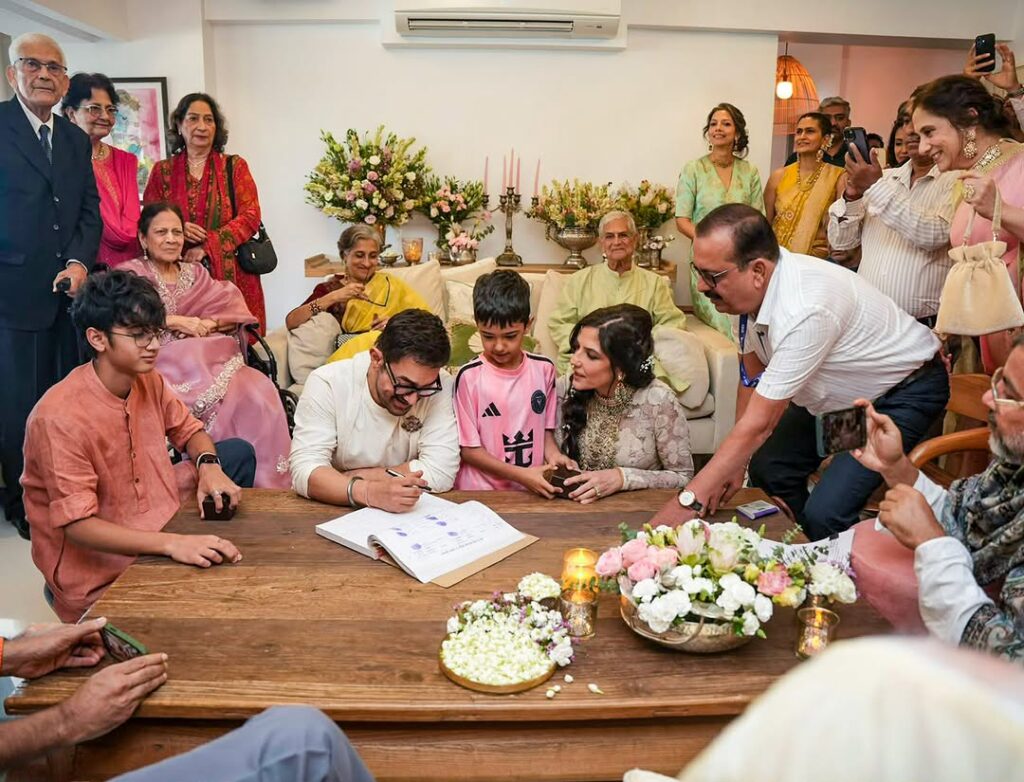
According to British film scholar Christine Gledhill, stardom never works in isolation; rather, it is inherently intertextual. When the audience watches Aamir Khan as the compassionate art teacher in Taare Zameen Par or the determined father and wrestling coach in Dangal, they don’t just watch an actor transform from one character to another; they engage with the accumulated meanings attached to his star persona. These meanings come from his on-screen and off-screen choices. Both become a text for the audience to read and decipher. A star’s private life, then, is never fully private; it is always also performance, with public consequence.
So, the question remains, what statement does a third marriage of a star like Aamir Khan make? Is it the profile of a hopeless romantic? A demonstration of the power to keep “accumulating”, be it status, capital, or even relationships? A quieter nod to polygamy dressed in the modern language of self-aware love? Maybe it is a mixture of all.
Last year, Aamir Khan gave a five-hour-long interview to Sourabh Diwedi on Lallantop. Out of five hours, he dedicated an hour to discussing his first marriage with Reena Dutta. He revealed that his romance began through a window like the film ‘Padosan,’ and within four months of knowing each other, they got married without telling anyone. They even lived separately for a brief while until their parents found out about them. Aamir Khan cried twice while discussing the hardships they witnessed as a couple. After being together for 16 years, the two separated in 2002. While talking about his divorce, he confessed to becoming an alcoholic and living in complete isolation for more than one and a half years. Suggesting a deep connection with Reena Dutta’s parents even after the divorce, the actor kept referring to them as Mummy and Daddy. Interestingly, Gauri Spratt, then girlfriend and now his wife, was also present in the audience. What’s left for us to weigh is whether that kind of unguarded emotional disclosure is genuine vulnerability or a practised means of making multiple, overlapping relationships legible and sympathetic to an audience.
We encounter the same bewilderment when Anupama Chopra, a film critic and editor of Hollywood Reporter India, calls Aamir Khan and Kiran Rao’s relationship “the most successful, influential, and fertile collaboration that survived divorce.” In response, the two filmmakers assert their allegiance as creative partners while arguing their divorce is not a comment on their working relationship. The duo collaborated on multiple critically acclaimed and box office hit projects, including ‘Taare Zameen Par,’ ‘Peepli Live,’ ‘Jaane Tu Ya Jaane Na,’ ‘Dangal,’ and ‘Secret Superstar.’ Reportedly, Aamir Khan met Kiran Rao in 2001 during the filming of Lagaan. Falling in love with her ‘intelligent mind,’ the actor married her in 2005 and filed for divorce in 2021. The two filmmakers, however, continued to work together on various projects, including ‘Laapata Ladies,’ India’s official entry to the Oscars in 2025.
Kiran Rao, in an interview, confessed that her parents feared she would become a shadow under the superstar persona of Aamir Khan. She also remarked that the traditional institution of marriage can feel “stifling,” particularly due to societal expectations placed on women. Looking for more space to grow independently, the filmmaker chose to separate herself from Aamir Khan. She, in fact, launched her own production house, ‘Kindling Pictures,’ which collaborated with Aamir Khan Productions for ‘Laapata Ladies.’ This collaboration is its own small case study in how thoroughly a former marriage can persist as infrastructure. That persistence is worth sitting with.
Aamir Khan, Reena Dutta, and Kiran Rao have all maintained visibly cordial ties after separating, but it’s hard to fully separate that cordiality from the sheer gravitational pull of the star’s cultural and economic capital. Even when Kiran Rao claims to work on her new production house, she could not possibly come out of the aura of Aamir Khan. The celebrity capital often extends well beyond the duration of a marriage. Which raises an uncomfortable question: when one partner holds this much cultural authority, how much of the “mutual, evolved love” narrative is genuine, and how much is required for both parties to preserve what they’ve built together?
Religion sits at another edge of this. Islamic law permits polygamy for men under specific conditions. While the actor hasn’t been involved with multiple partners at the same time, the accumulation of three sequential marriages, each maintained afterwards as an ongoing relationship, sits close enough to that framework to invite comparison. Then what makes Aamir Khan any different from the YouTuber, Arman Malik, who has built content around openly having two wives? What separates the two men’s reception is not the structure of their relationships so much as class, platform, and the different cultural licence extended to a so-called ‘national icon’. It’s also worth asking why Banu Mushtaq’s Booker-winning book Heart Lamp, a collection of stories of Muslim women abandoned for younger brides, reads as tragedy, while a beloved star’s third wedding reads as a fairytale.
The debate also intersects with patriarchy. Muslim social norms have historically extended men considerable room to hold multiple significant relationships across a lifetime without real cost to their public standing. However, women are held to a stricter, more punitive standard. It’s fair to ask whether an equally celebrated actress, remarrying for the third time after two divorces, would be met with the same warmth, humour, and generosity? The asymmetry says less about any individual and more about how resilient patriarchal double standards remain, even in progressive-seeming spaces like the film industry.
One more pattern invites scrutiny here. All three of Aamir Khan’s marriages have been to women raised as Hindu women. It could be read through the lens of Love Jihad. While it might be a mere coincidence, the three weddings do provide a template for young Muslim men to replicate in a polarising society.
Social media users across India are seeking permission to apply Aamir Khan’s formula to believe in the institution of marriage. And that should be most concerning! In a moment when relationships are already discussed with cynicism or as a transaction. The recent high-profile cases of Twisha Sharma and Siya Goyal are a testament to the fear around the family value system. An algorithmically rewarded narrative of “finding love on your third try” risks selling precisely the isolation Sahil warned about in his review of Obsession. A culture that profits from disconnection doesn’t need to attack love. It only needs to offer glossy and repeatable templates for leaving and starting over again for the market to thrive.
(The writer is a PhD scholar at Centre for Media Studies, Jawaharlal Nehru University and a film critic.)