
INRODUCTION
Media laws in independent India safeguard press freedom while ensuring responsible communication. Rooted in Article 19 of the Constitution, they set boundaries to protect national security, public order, and morality. From the Press Council Act to the IT Act, these laws regulate print, broadcast, and digital media in the world’s largest democracy. Following is the list of media laws introduced, or amended in Independent India:
| S.No. | NAMES | YEAR | KEY POINTS |
|---|---|---|---|
| 1. | The Embems and Names (Prevention fo Improper Use) Act | 1950 | |
| 2. | Press (Objectionable Matters) Act | 1951-56 | 1. Passed alongside the ammendment in article 19(2). 2. Enacted to penalise the ‘abuse of press freedom’ by publishing content that encourage voilence, sabotage, or other serious offence. 3. Empowered government to demand and forefit security of objectionale matters. 4. Primary for press keepers and publishers. 5. Repeled many other simmilar center, state and concurrent laws related to the simmilar issues. |
| 3. | The Cinematograph Act | 1952 | 1. The law provdes of the certification and censorship of films and how to constitute boards for film certifaction. 2. Section 3: Provides of the establishment of Central Board of Film Certification (CFBC). – Consits of 12 to 25 members plus a chairman. 3. Section 5(a): Types of Certificates: – U = Universal; U/A = Universal with adult discretion. – A = Adult (nudity allowed); S = Specialised class like doctors, scientistis. After 2023 amendments – – U/A 7+; U/A 13+; U/A 6+. – Aligns with IT Rules 2021 and Shyam Bengal Committee report. 4. Section 5(b) provides all the reasonable restrictions in the name security, soverentiy, contemt of court and demation etc. New in 2023 Amendment – 1. Incresed the scope from certification to ‘copyright’ and ‘anti-piracy.’ – Anti-Piracy Provisions: 3 months to 3 years plus 3 lakh to 5% of gross production cost. 2. Goverment will no longer have revisonal power over CBFC decision, based on the Supreme Court’s judgment in the case of K.M. Shankarappa vs Union of India (2000). 3. Require seprate ccertificate for T.V. and other medium. 4.Perpetual validity of the certificate. Cinematograph Certification Rules, 2024 1. Makes the process of film certifcation easier and quicker by digital means like epraman. 2. Greater women representation by 1/3 mandatorly and preferbly half of CFBC board being women. 3. System of priority screening. |
| 4. | The Delivery of Books and Newspaper (Public Library) Act | 1954 | 1. Section 3(a): Free Copy to Library within 30 days – National Library, Calcutta. – Connemara Public Library, Madras. – Central Library, Bombay. – Delhi Public Library, Delhi. 2. Section 5 – Fine: Upto 50 rupees or cost of one book. |
| 5. | Drugs and mageical Remedies (objectionable ad) Act | 1954 | 1. Claims to have magical power to cure, diagonose, prevent, or mitigate desease in human or animal. |
| 6. | Working Journalist Act | 1955 | – Section 8: Fix rate and revise them from time to time. – Section 9: Guidelines of contitutin a wage board – 2 WJ + 2 Employers + 3 indepent (one judge, Chariman) under 13C. 6 wage board so far: – Palekar – Bachawatt – Manisana – Majithia |
| 7. | Prize Competitions Act | 1955 | |
| 8. | Registrar of Newspaper | 1956 | |
| 9. | Young Persons (Harmful Publication) Act | 1956 | |
| 10. | The Parliament Proceedings (Protecction of Publication) Act | 1956 | 1. True reporting of proceedings. 2. 6 months with or without fine; Subsequent upto 1 year. |
| 11. | Newspaper (Price and Page) Act | 1956-62 | 1. Regulate price of newspaper in relation to thier pages to prevent unfair competition. 2. On the basis of first press commision. |
| 12. | Copyright Act | 1957 | 1. Copyright is a legal right that protects original works of literature, art, music, films, and computer programs, among others, in India. It safeguards expressions of ideas rather than the ideas themselves. 2. Key Sections: – Section 2: Deals with various definitions of the work which can be covered under the definition of copyright. – Section 13: Provides copyright protection to literary works, musical works, dramatic works, cinematographic films, and sound recordings, among others. – Section 14: Grants the copyright owner a set of exclusive rights such as adapting, reproducing, publishing, translating, and communicating the work to the public. – Section 52: Certain exceptions. 3. Copyright provide civil, criminal and administrative remedies under section 55(civil) and section 56(criminal). – Injuction: Temporary or permanent order by court to prevent further infringement. – Criminal: 3 years not less 6 months; 50,000 to 2 lakh; Seacrch and seizure. 4. Section 57: Aurthor special rights (moral rights), form Berne Conviction. |
| 13. | Defence of India Act | 1962 | |
| 14. | Unlawful Activities (Prevention) Act | 1967 | |
| 15. | Contempt of Court Act | 1971 | Disrespect to the dignity or authority of the court. – Civil = wilfull Disobedience. – Criminal = Scandalise statement or publication undermining public confidence in judiciary. – Protected under 19 (2); Seprately under: – Article 121 for supreme court. – Article 215 for high courts. – Truth and good fiath as defense. – Punishment: Can extend upto one year or fine or both. |
| 16. | Prevention of Insults to the National Honour Act | 1971 | 1. Aims to protect the national flag, anthen, and emblem form insult or disrespect, ensuring revernce and dignity for national symbols. |
| 17. | Newspaper (Price Control) Act | 1972 | require attention |
| 18 | Criminal Procedure Code (CrPC) | 1973 | Bhartiya Nagrik Surakhsha Samhita, 2023 |
| 19. | Prevention of Publication of Objectionable Matter | 1976 | |
| 20. | Parliamentry Proceeding (Protection of Publication) Repeal Act | 1976 | – Reancted in 1977 |
| 21. | Press Council (Repeal) Act | 1976 | – Reancted in 1978 |
| 22. | Indecent Representation of Woman Act | 1986 | 1. Prohobits indecent representation of woman through ads, or publications, writings, painting, figures or in other manner. 2. Fine: – First: Upto two years of jail and 2000 fine. – Subsequent: 6 months to 5years and 10k to 1lakh. |
| 23. | Prevention of Atrocities (SC/ST) Act | 1989 | 1. Article 17: Abolish untochability. 2. Article 46: Promote education and economic interest of SC and ST. |
| 24. | Cable T.V. Nretworks Regulation Act | 1995 | 1. To regulate haphazard mushrooming of cable TV network and protect against cultural invasion. Two step regulation: – Registration – Regulate Content 2. 2003, Amendment introduced ‘Condtional Access System.’ Handelled by TRAI since 2004. 3. 2011, Amendment called to ‘digitise cable sector by 2014. Fine – 2 years or 1000 or both – 5 years or 5000 or both |
| 25. | IT Act | 2000 | 1. Sanction e-commerce, and e-transaction. Meanwhile enable e-governance and prevent cyber crime. Section: – 66A: arrest offensive content online and social media, upto 3 years with fine. Added by ammendment in 2008. – 66E: Punishment for violation of privacy. – 69A: Survilance and block. 2. 2018, ammendment guidelines to ‘intermediaries’ under senction 79(2)(C). 3. IT (Intermediary Guidelines and Digital Media Ethics Codes) Rules, 2021. – Aimed at making internet open, safe, trusted an accountable. |
| 26. | RTI | 2005 | |
| 27. | Digital Personal Data Protection Act | 2023 | – To safeguard the personal data of individuals and ensure that their data is shared only with their consent. – Regulating processing of presonal digital data. Data Fiduciary– A data collecting, storing, and sharing entity. – Data fiduciary also acts as a “Consent Manager” who enables a DP to give, manage, review, and withdraw consent through an accessible, transparent, and interoperable platform. – Data Processor–an entity processing the data on behalf of a data fiduciary. Both Data fiduciary and data processor could also be the same in certain small entities. – Data Protection Officer (DPO): – could be any individual appointed as DPO by a Data Fiduciary under the provisions of this Act. |
CONCLUSION
India’s media laws strive to balance free speech with accountability. As technology reshapes communication, regulations must evolve to protect democratic values while curbing misuse and misinformation.
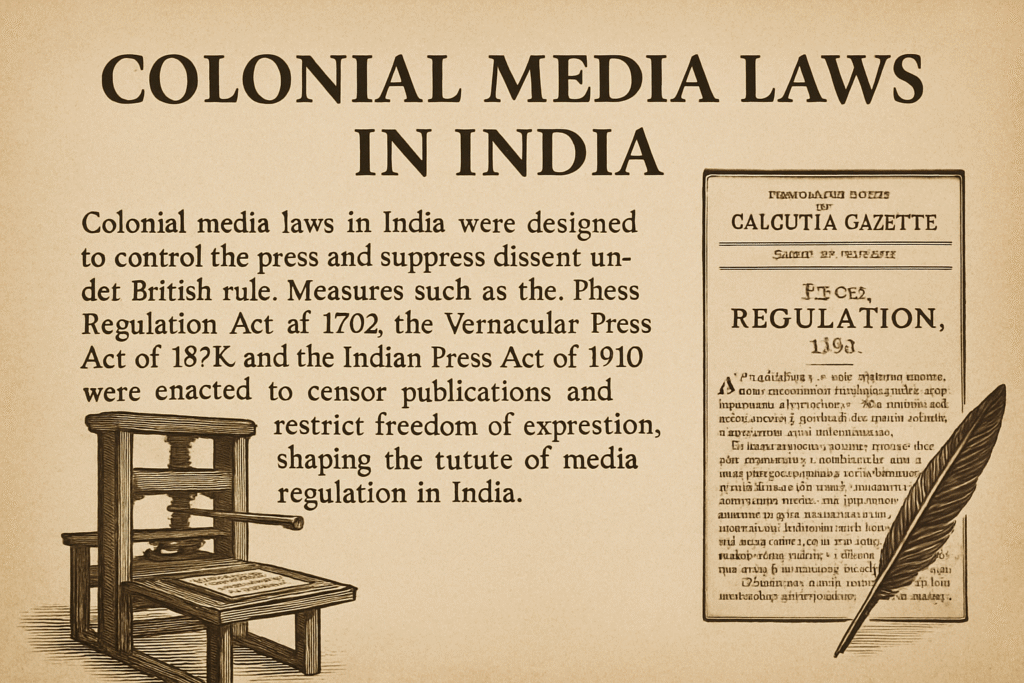
Furthermore, to read the list of colonial law : Click Here!
Pingback: Media Laws in Colonial India | Media Decoded